
Successful Project Halo Workshop held in Suva to assess sites for regeneration in Fiji.
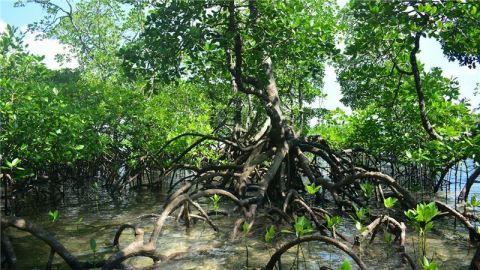
Mangroves are a type of halophyte — a salt-loving plant that grows in or near tidal water sources. Mangroves store four times more carbon than terrestrial forests. Their branch and root structure provide an ideal breeding ground for juvenile coral and fish, with 30% of global fish species mangrove dependent. Mangroves are also home to various bird species, including egrets, herons, kingfishers, hawks and osprey. Mangrove ecosystem loss globally is resulting in reduced carbon sequestration, declines in marine and estuarine water quality, reduced biodiversity and a decrease in sustainable fishing yields.
Workshop participants represented the breadth of Pacific Community development, marine and environmental organisations, including the Pacific Community (SPC)’s NDC Hub, opens in a new window, which supports Pacific leadership for climate action, the Secretariat for Pacific Regional Environment Programme, (SPREP), opens in a new window and their Pacific Ecosystem-based Adaptation to Climate Change (PEBACC), opens in a new window project, and the MACBLUE, opens in a new window (Management and Conservation of Blue Carbon Ecosystems) Project, GIZ’s Pacific offices, also working in the MACBLUE Project, the Locally Managed Marine Area network (LMMA, opens in a new window), Conservation International, opens in a new window (CI) ‘s Pacific offices, Birdlife Internationaland NatureFiji-MareqetiViti, opens in a new window.
With funding from Swire Shipping, opens in a new window, and endorsement from the Fiji Office of the Prime Minister for a pilot project, Project Halophyte seeks to 1) re-instate natural tidal flows in degraded coastal lands and 2) integrate mangroves within existing and new marine infrastructure.
These two nature-based solutions aim to revitalise the local mangrove ecosystems in both degraded and urban landscapes in Fiji in partnership with local communities, for the benefit of people and the environment. Over five years, researchers will track the environmental, social, and economic outcomes of Project Halo in Fiji, and researchers have plans to scale across the Pacific with further regional and national collaborations.
With the funding support of SK Innovation from South Korea, the Pacific Community (SPC) Land Resources Division (LRD), will be jointly implementing the project with the Fiji MoFF, and the three coastal communities in Vanua Levu, Fiji.
The project agreement was signed in October 2023, but the implementation of the activities commenced from June 2024 for a one year period up to May 2025.
Restoration of 9 hectares of mangrove ecosystems in Vanua Levu, Fiji.
Loraini Baleilomaloma: lorainib@spc.int